
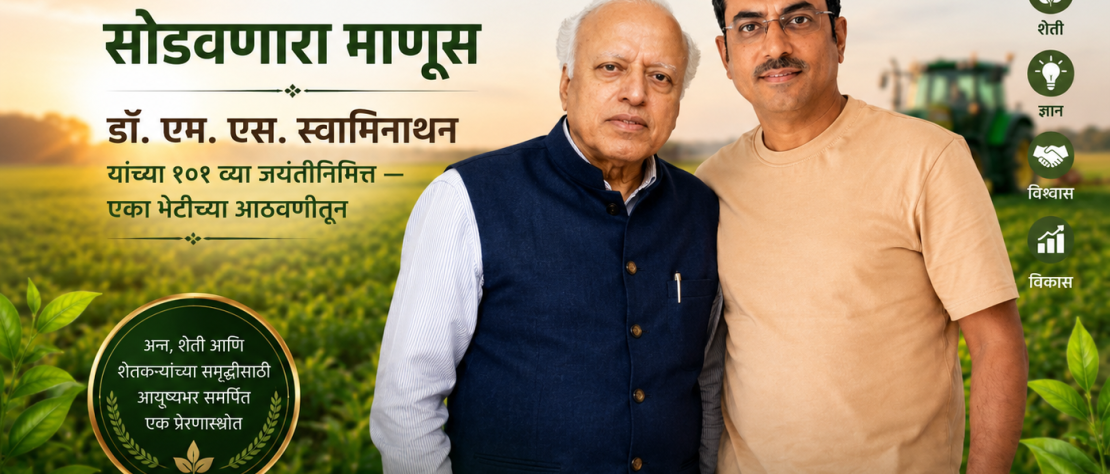
Remembering Dr. M. S. Swaminathan on his 101st birth anniversary — from a morning at the Taj
Vijay Gaikwad
On 7 August 1925, in Kumbakonam, Tamil Nadu, a boy was born into a family of landholding farmers who expected him to become a doctor. He chose seeds instead. What changed his mind was the Bengal Famine of 1943, in which more than three million people starved to death. Medicine, he later reasoned, could save a few lives; agriculture could save millions.
That decision has a name: Dr. Mankombu Sambasivan Swaminathan. Today is his 101st birth anniversary — and it is not merely a scientist’s birthday. It is the anniversary of the idea that India need not wait for someone else’s ship to eat.
A nation waiting at the docks
By the mid-1960s the average Indian was living on roughly 417 grams of food a day, dependent on unreliable American wheat shipments. Waiting for grain ships had become a national trauma. Prime Minister Nehru had to ask citizens to substitute sweet potato for wheat. Decades of colonial policy had left Indian agriculture stagnant — low yields, exhausted soils, farmers landless or indebted.
Swaminathan took his PhD in plant genetics at Cambridge, worked in the Netherlands and at the International Rice Research Institute (IRRI) in the Philippines, and in Mexico met Norman Borlaug, whose semi-dwarf wheat would become the backbone of the Green Revolution.
In 1963 he persuaded Borlaug to send Mexican wheat strains to India. Three years later the country imported 18,000 tonnes of seed for a nationwide trial. Nothing about it was smooth. Bureaucrats feared dependence on foreign germplasm. Shipping and customs slowed everything down. Farmers clung to the tall varieties they knew.
He answered with data, advocacy and shoe leather — walking the fields with his own family, placing seed directly into farmers’ hands. In Punjab, to get packets stitched fast enough for the sowing window, he enlisted prison labour.
One detail captures his instinct for the farmer better than any statistic: Mexican wheat was red, and red wheat would not do for naan and roti. He ensured the Indian hybrids came out golden. They were named Kalyan Sona and Sonalika — sona, gold. By 1971 yields had doubled. In four years, a country on the edge of famine had a surplus.
Farmer-first, and the field as laboratory
His real originality lay less in the varieties than in the posture. The field is also a laboratory, he insisted, and the farmer is also a scientist — one who often knows more than the researcher does. Scientists, in his view, were obliged to listen before they prescribed.
So he spent weekends in villages asking about soil moisture, seed prices and pest pressure. In Odisha he worked with tribal women to improve rice varieties. In the dry belts of Tamil Nadu he pushed salt-tolerant crops. To sceptical Punjab landowners he said plainly that science alone would not end hunger — that science had to walk alongside compassion.
As chairman of the National Commission on Farmers he delivered five reports between 2004 and 2006. The final one went to the roots of agrarian distress and rising farmer suicides and called for a comprehensive national farmers’ policy. At 98, he still stood publicly with the farmers protesting in Punjab and Haryana.
His reach extended well past India. As the first Indian Director-General of IRRI he carried high-yield rice across Southeast Asia, lifting output in Indonesia, Vietnam and the Philippines. He helped rebuild Cambodia’s rice gene bank, supported African agronomists through the Ethiopian drought, shaped China’s hybrid-rice programme and helped spark Africa’s own Green Revolution.
In 1987 he became the first recipient of the World Food Prize. Much of his 1971 Ramon Magsaysay Award money went to rural scholarships. In 2024, the nation conferred the Bharat Ratna on him.
He was also the first to name the costs
Swaminathan never pretended the Green Revolution was free. Intensive farming drained groundwater, degraded soils and left pesticide residues; wheat and rice monocultures eroded biodiversity and deepened climate vulnerability, especially across Punjab and Haryana. He acknowledged all of it — and in the 1990s proposed the Evergreen Revolution: high productivity without ecological harm. Future gains, he warned, would come not from fertiliser but from conserving water, soil and seed.
A morning at the Taj
I did not learn all this from books alone. I had the good fortune of sitting across from the man.
It was 2009. I was a reporter for Agrowon, working out of the Fort office in Mumbai. Our editor Nishikant Bhalerao called, as he often did: AP — Abhijit Pawar, Managing Director of Sakal — wanted a term relating to dryland farming explained by Dr. Swaminathan himself.
I called the M. S. Swaminathan Research Foundation in Chennai and learned that he was in Mumbai, staying at the Taj. A scientist past eighty, in the city on work, with no assistant and no mobile phone.
I went straight there. The reception politely declined to share his room details but said he had stepped out, and that if I waited I might catch him in the lounge. Half an hour later an elderly white-haired gentleman walked in, unaided. I recognised him, rose, and introduced myself.
He sat me down beside him on the lounge sofa. I dialled Abhijit Pawar on my ordinary non-smartphone and handed it over. For the next twenty-five minutes — with the patience of a grandfather explaining something to a grandson — he cleared every question about rainfed agriculture.
The call ended. It was time to leave. I asked: “Dr. Swaminathan, if you don’t mind, I wish to have your interview for Agrowon.”
He replied, “Beta, today I am busy with meetings. Tomorrow morning you come to my room, we will talk.”
I took that lined hand in mine and left. The next morning, with my friend Abhay Joshi, I went back to the Taj and recorded a special interview.
“Conservation agriculture is non-violent agriculture”
What he said in that interview reads even truer in the climate-stressed present.
The Fourth World Congress on Conservation Agriculture had just been held in Delhi. He defined conservation agriculture as raising productivity through joint farmer-scientist research while protecting soil, water and biodiversity — and without disturbing natural cycles at any point.
Then came the formulation I have never forgotten: apply Gandhi’s principle of non-violence to farming, and what you get is conservation agriculture. Another name, he said, for the Evergreen Revolution.
His economic analogy was just as precise. Farm the way a household lives off interest without touching the capital. Most Indian farmers hold under a hectare; they genuinely need higher productivity — but not productivity bought by liquidating natural capital.
On zero-tillage he was refreshingly blunt. Fukuoka’s zero-tillage, from The One-Straw Revolution, is one component of conservation agriculture, not the whole of it. Where erosion is the binding problem, it works. But the hard red soils of Tamil Nadu, he said, have to be tilled to be loosened. And telling farmers to spray herbicides instead of tilling, when labour is available, is company marketing rather than agronomy.
On Punjab, Haryana and western Uttar Pradesh he was warning us early: excess water and fertiliser, chased in pursuit of higher yields, had salinised fertile land and pushed the water table down. The rest of the country, he argued, should not imitate that model. Taking an acre from one tonne of rice to four raises marketable surplus and is necessary — but the environment must not pay the bill.
And the closing principle, always the same: without farmers’ participation, scientists cannot complete this research on their own.
On this day
Maharashtra today is caught in the loop of climate change — unseasonal rain, hail, erratic monsoon withdrawal, unstable fertiliser supply chains, and an unresolved argument over remunerative prices. Swaminathan’s reports identified every one of these two decades ago.
The most honest tribute we can pay on this anniversary is to record plainly that the Swaminathan Commission’s recommendations remain unimplemented. The man who ended the country’s hunger spent the rest of his life asking for one thing: that the farmer be paid fairly for his sweat.
Respectful salutations to the scientist who made Indian agriculture self-reliant.
Jai Kisan, Jai Samvidhan
— Vijay Gaikwad